When people around the world put on a soft cotton T-shirt, it often feels like the simplest thing in the world. However, for people living near the Thetsane Industrial area in Maseru, every T-shirt carries a story of survival, loss and resilience.
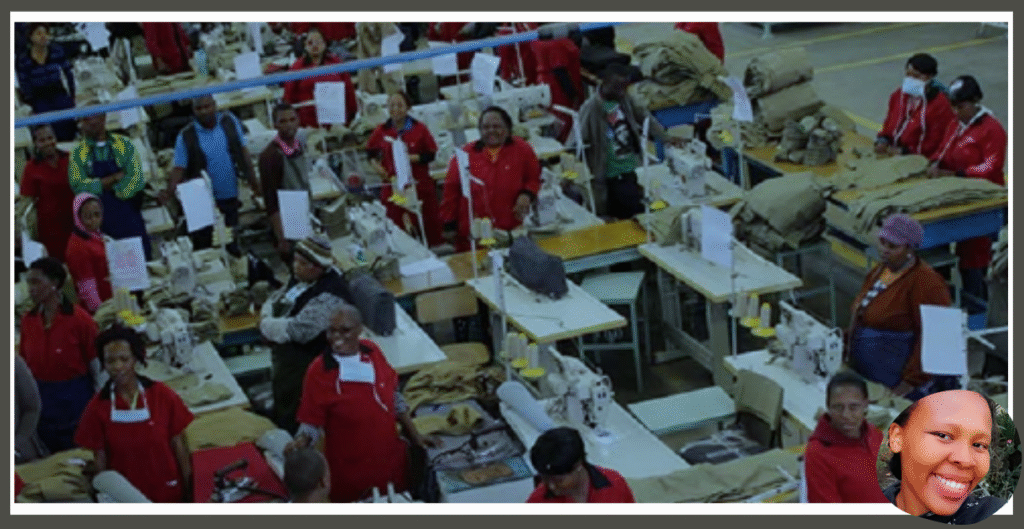
Thetsane was once alive with the hum of sewing machines. Women walked to work before sunrise, and the factory gates spilled open at the end of each day with tired but proud workers. Their wages, though extremely modest (the average wage is about $66 a month), paid school fees, kept rental rooms occupied and gave local shop owners steady customers. That rhythm changed when global trade disputes and tariffs struck Lesotho’s textile exports. Suddenly, orders from United States slowed. Factories cut hours, some shut down completely. The familiar hum of machines gave way to silence.
What It Means for Local Communities
The fallout is visible in every corner of Thetsane and beyond. Rental houses stand half empty, their landlords losing income. Small shops that once sold bread, maize meal and paraffin now sit quiet, because the women who sewed jeans and T-shirts no longer have wages to spend.
I’ve spoken to neighbors who worked for over a decade in the factories. One woman told me, “I used to feed three children with pay. Now I borrow maize from relatives whom are also struggling and I don’t know when I’ll repay it.”
The ripple effects don’t stop at food. Children are being pulled out of school when parents can’t afford fees. Health suffers when money for clinics and medicine run out. Those who return to rural villages lean heavily on fragile land, deepening environmental strain.
Many have taken an even more desperate measure: crossing the border into South Africa. With factories closed and no alternative at home, men and women alike risk migration to Johannesburg, Durban or the mines. Some find jobs as domestic workers, miners, hair dressers, construction workers or security guards but many are undocumented, facing harassment, exploitation or unsafe conditions. Families are split apart as parents leave children behind in search of a wage, often sending back less money than they once earned in Lesotho’s factories.
The Role of Local Leadership
It would be unfair to say Lesotho’s struggles are solely caused by global trade wars. The truth is, some of our challenges come from limited planning at home. For years, the textile industry has been the backbone of Lesotho’s private sector. Yet little has been done to diversify the economy or provide strong safety nets when factories close. Instead of long-term strategies, responses have often been shot-term and reactive. This means that when external shocks hit like tariffs or global recessions, workers and small businesses in places like Ha-Thetsane are left with few alternatives. There is a chance to change this. With investment in education, technology, agriculture and renewable energy. Lesotho could reduce overdependence on textiles. Communities could be more resilient and workers would not feel forced to migrate to South Africa just to survive.
The Bigger Picture
Lesotho, often called the “Kingdom in the Sky,” is small yet its garment industry was a global success story. Trade agreements allowed us to supply major U.S. brands, employing tens of thousands of mostly women workers. For a time, this was one of the most significant drivers of poverty reduction in the country. But policies made far away, tariffs, trade wars, shifting supply chains and the lack of strong visionary leadership at home can unravel decades of progress overnight. In Maseru, you can see global politics not on a screen but in empty rental rooms, in shuttered corner shops, in the children left behind when parents migrate and in the quiet worry etched on people’s faces.
Why This Matters Beyond Lesotho
To many consumers abroad, Lesotho’s is invisible. They don’t know where their T-shirt was made, let alone who stitched it together. Yet the choices made by global leaders, international brands and local politicians ripple directly into communities like Thetsane. This why ethical sourcing, fair trade and supportive trade policies matters. It’s also why good governance at home matters: leaders must strengthen education, diversify industries and provide social protections so that the people of Lesotho are not left vulnerable every time global politics shift.
A Call for Empathy and Accountability
Behind every T-shirt, there is a worker, a mother, a community. And here in Lesotho, we see every day what happens when those threads are cut. As a global community, we have the power to weave a different story, one where trade uplifts rather than destroys. Where leadership, both global and local, is accountable to the people it claims to serve. Because here, in the Thetsane Industrial Area, I’ve learned something yet profound: a T-shirt is never just a T-shirt.